

JESSE JACKSON, 1941-2026
Remembering an American icon, and how he briefly touched my life while America trembled ...

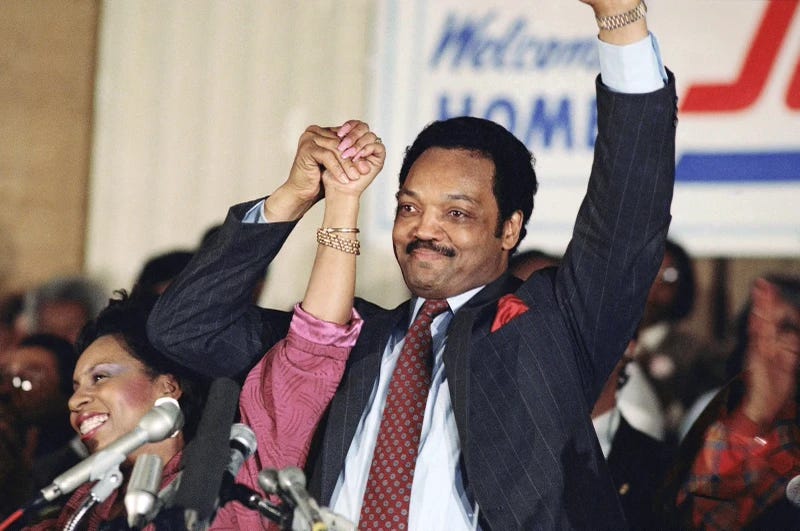
If the worst thing you can say about Jesse Jackson is that he was a flawed man, it is also the best thing you can say about any of us, because not one of us is perfect.
Jackson, an iconic civil rights leader, father, husband, son, two-time Democratic presidential contender, and true American icon died this morning. He was 84.
I am not remotely qualified to write this man’s obituary — there are some wonderful remembrances out there — but I wanted to say just a few words in recognition of his very important life, and my brief, memorable interaction with him 25 years ago.
You cannot write a thorough biography of America, without including a chapter on Jackson, who was born Oct. 8, 1941, in Greenville, South Carolina.
It is fair to say his stirring presidential bids in 1984 and 1988, made it possible for another African American, Barack Obama, to win big in his subsequent runs for the presidency in the 2008 and 2012.
Obama said as much this morning via social media:
“Michelle (Obama) got her first glimpse of political organizing at the Jacksons’ kitchen table when she was a teenager. And in his two historic runs for president, he laid the foundation for my own campaign to the highest office in the world.”
Jackson, who spent most of his professional life championing equal rights for all of us, was with Martin Luther King Jr. on April 4, 1968, when the civil rights leader was slain at the Lorraine Motel in Memphis Tennessee.
Jackson’s accounting that King’s last words were directed at him while he cradled him in his arms came under much dispute in the ensuing years by other prominent people in King’s inner circle. It tarnished Jackson’s image of a selfless freedom fighter, and instead made him look like a selfish attention-seeker trying to capitalize on King’s horrible death to bolster his burning, personal ambition.
The New York Times chronicled it this way in their comprehensive obituary this morning:
If Mr. Jackson had been a figure of suspicion before, he became an object of outrage after Dr. King’s death. Some in Dr. King’s inner circle — including his eventual successor, Mr. Abernathy, and Hosea Williams, both of whom rushed to Dr. King when he was shot — questioned the accuracy of Mr. Jackson’s account and resented what they saw as his calculated grab to seize the spotlight as the First Mourner.
Jackson took issue with these characterizations, while steadfastly going forward and soaring ever higher as one of America’s foremost civil rights and political leaders. By 1987, Abernathy said this of Jackson, as he set out on his second presidential bid:
“I hope God has forgiven him. He has had time to pray. He is a different man now.”
This much is undeniably true: Jackson was a charismatic man, and a beautiful, passionate speaker who could make entire auditoriums quake. He did as much as anybody in my lifetime to make the impossible possible, which also made him a force of nature.
Just ask Obama.
I always considered my brief interaction with him to be a metaphor for his life.
We were standing outside the U.S. Supreme Court building among a modest, well-behaved crowd where a little thing like the fate of the free world was being decided. It was an uncommonly warm, sunny, early-December day that belied the enormity of the moment, because dark clouds were brewing inside the building that would usher in a cold, hard decision that would change America’s future for generations to come.
It was the Year 2000, and Vice President Al Gore and his Republican challenger, George W. Bush, were locked in a virtual dead heat in the presidential election with only Florida to be decided.
Jackson’s days as a political heavyweight were over, but his charisma and notoriety were still shining just as brightly as ever.
Major media were crowded on the lawn in front of the court. Fox News was appropriately positioned to the right, and other media outlets were camped out on the left.
I stationed myself somewhere in the middle of this carnival atmosphere just taking it all in. I was the Managing Editor Of Stars and Stripes at the time, but on this day I was simply an observer, not a reporter. Our offices in the city’s venerable National Press Building were within walking distance of the Supreme Court, and I thought it my job to bear witness to one of those heady days in America when history briefly stood still.
That’s when Jackson loudly arrived on the scene and took center stage.
All eyes went to the instantly recognizable man as he stole the show, and held his own version of court. I’ll never forget the smile he had on his face as he moved through the crowd. It seemed to bely the urgency of the moment, yes, but also humanized it, and for that I was thankful.
When he would walk to the left side of the crowd and toward those news cameras he was cheered. When he was done there and walked toward the right side he was roundly booed. Always a showman, he picked up on this and started walking back and forth to be cheered while striding in one direction, only to be booed when he did an about-face and moved toward the right.
Finally, he plumbed the middle and stood in place just a few yards in front of me, where smiling, he’d simply raise his left arm to be cheered, and his right arm to be booed.
“Yay!!-Boo!! … Yay!!-Boo!! … Yay!!-Boo!!”
When he’d wrung all the fun he could get out of that, he walked off the stage he had erected for himself, and toward me. I reflexively stuck out my hand to shake his. He grabbed it and laughing said, “America the beautiful right there. You gotta love it, my man.”
I laughed, better for the human touch.
And just like that the man who will never be forgotten was in a limo and gone.
Rest in peace, Jesse Jackson. We’ll all keep doing our best to keep hope alive.
(D. Earl Stephens is the author of “Toxic Tales: A Caustic Collection of Donald J. Trump’s Very Important Letters” and finished up a 30-year career in journalism as the Managing Editor of Stars and Stripes. You can find all his work here.)
Lovely words, Earl. I remember that day when SCOTUS stopped the ballot count in Gore vs Bush. I could not believe they would do this when it was so close. I really do believe Gore would have won. It wasn't even a unanimous vote.
Earl, what a effervescent full of life memory for you. Thanks for sharing.